A firsthand account of discovering and automating crypto arbitrage — from stumbling on a 5% price gap to running a bot that paid for itself on day one.


A professor from the Chicago School of Economics and a street-smart trader were walking across a college campus. The professor firmly believed the market was perfect; the trader believed it was full of holes.
Suddenly, the trader pointed at the sidewalk and shouted, "Look! A twenty-dollar bill!" He leaned down to pick it up.
The professor grabbed his arm, not even bothering to look down. "Don't be silly," he said calmly. "It's an optical illusion. If there were real money on the ground, someone would have picked it up already. According to the Efficient Market Hypothesis, there's no such thing as a free lunch."
The trader paused, then shook off the professor's hand, walked over, and snatched the bill. He checked it—it was real—and stuffed it into his pocket.
Smiling at the professor, he said, "In theory, this shouldn't exist. But in reality, here it is. And the only reason it was still there for me to find is because people like you were so convinced it had already been taken."
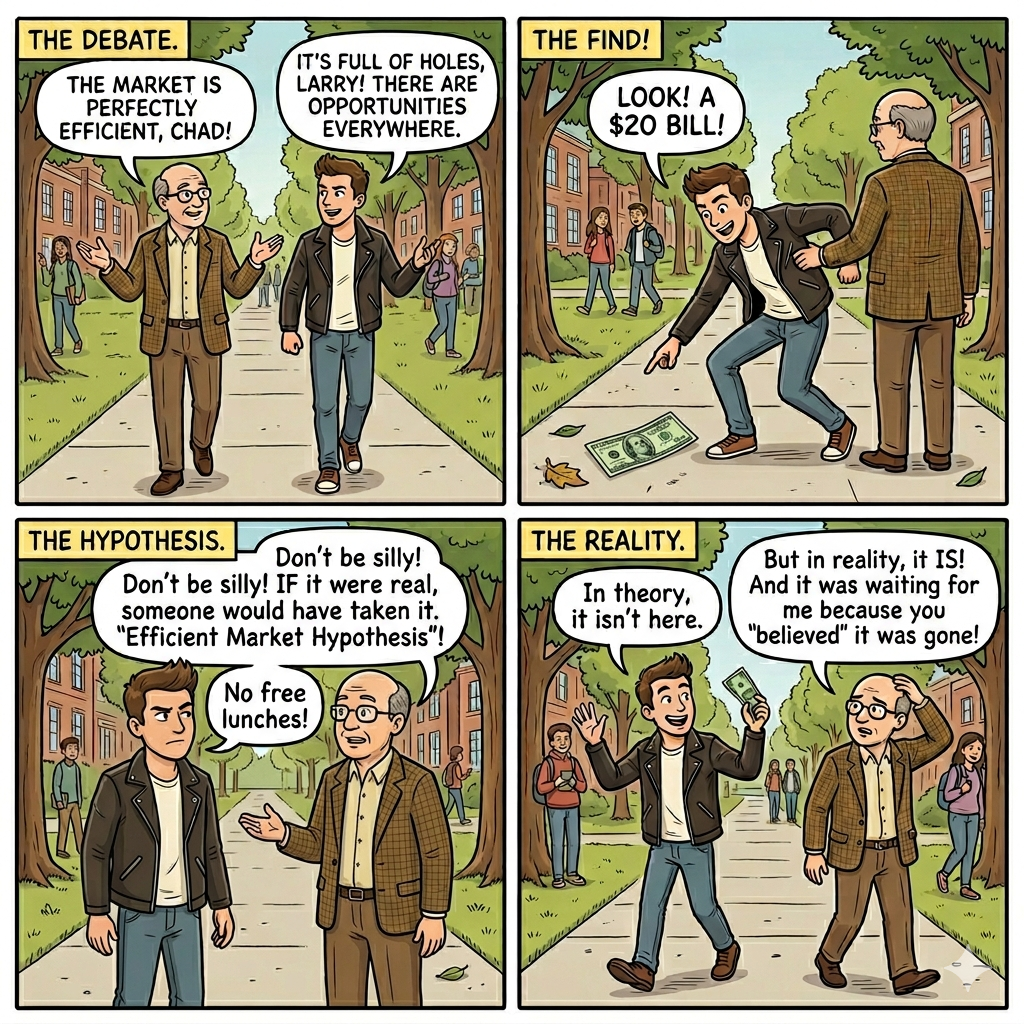 This story is a classic satire of the extreme "Efficient Market Hypothesis." The theory suggests that markets react so instantly that all information is already baked into the price. Therefore, arbitrage is impossible, and beating the market is a pipe dream.
A firsthand account of discovering and automating crypto arbitrage — from stumbling on a 5% price gap to running a bot that paid for itself on day one.
Crypto arbitrage is the practice of buying an asset on one venue at a lower price and simultaneously selling it on another venue at a higher price, capturing the spread. The trade is risk-controlled because both legs execute within seconds. In crypto, arbitrage exists between centralised exchanges, between DEX pools on the same chain, and between chains via bridges.
A DEX-to-DEX arbitrageur monitors prices of the same token across automated market makers — for example, ETH-USDC on Uniswap v3 versus SushiSwap. When the gap exceeds gas and slippage costs, a smart contract atomically buys from the cheaper pool and sells into the richer pool in a single transaction, often using a flash loan so the trade requires no upfront capital.
For repeatable profit, yes. Manual arbitrage was viable in 2017-2020 when gaps were wider and competition was lighter. In 2026 most opportunities close in milliseconds, so profitable arbitrage requires automation: a price-feed monitor, a transaction builder, and access to private mempools such as Flashbots or MEV-Share to avoid being front-run by other searchers.
Execution risk from slippage and partial fills, MEV competition (your transaction gets sandwiched or front-run), capital lockup across exchanges, smart contract risk on the DEXes used, and gas burn on failed transactions. Centralised exchange arbitrage adds counterparty risk: deposits and withdrawals can be paused, freezing one leg of the trade and leaving you with directional exposure.
Onchain arbitrage with flash loans needs near-zero capital but significant engineering expertise — the loan amount is borrowed and repaid within one transaction. Without flash loans, expect to need $10k+ to absorb gas and capture meaningful absolute profit per trade. Centralised-exchange arbitrage typically requires balances pre-positioned on every venue you trade between.

Practitioner turned analyst with firsthand experience running automated arbitrage strategies across DEX and CEX markets.


