The second edition of our monthly yield guide — and the first to widen past stablecoins. Nine vetted positions across low, medium and high risk, plus points farming and a spot-accumulation case, each with its Safety Score and the exact thing that would break it.


This is the second edition of our monthly, forward-looking yield guide — and the first under a new name. Last month it was the stablecoin yield guide. This month it is the DeFi yield guide, because the honest opportunity set no longer fits inside stablecoins: the best risk-adjusted returns on our board right now include an incentive-subsidised LP, two points-farming positions, and — for the first time this cycle — a case for simply buying spot.
The structure is unchanged. Every position below is graded on the DeFi Sentinel Strategy Safety Score, sorted from low risk to high, with the specific thing that would break it spelled out. None of this is financial advice.
August has been an ugly month for headlines and a quiet one for price. That divergence is the whole story.
The Coldcard disaster. From July 30, an attacker drained roughly 1,816 BTC (~$116M) from more than 5,200 addresses using a five-year-old firmware flaw in Coinkite's Coldcard, which seeded wallets from a deterministic software generator instead of the hardware RNG — making keys guessable. The victims were, definitionally, the most careful people in crypto. If you generated a seed on a Coldcard between March 2021 and the patch, treat it as compromised.
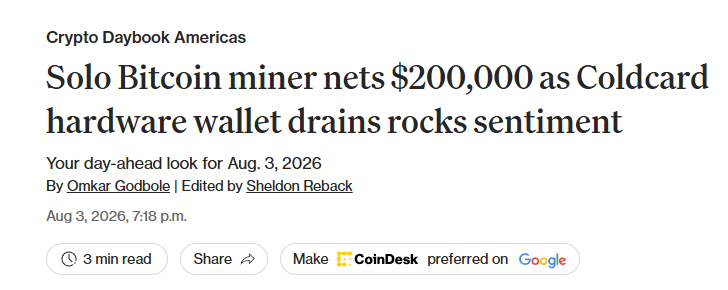 The story that set the tone for the month.
Two exchanges are winding down — BitMEX stops trading September 23, BitMart shuts January 31, 2027 — but neither is an insolvency; BitMEX states assets exceed liabilities. These are margin-compression closures, of which there have been 60-plus in 2026: consolidation, not contagion. The infrastructure keeps shipping regardless — Uniswap launched the Pools.trade launchpad on August 5, and Circle's Arc mainnet goes live September 16 with BlackRock, DTCC, ICE, Mastercard and Visa as founding validators.
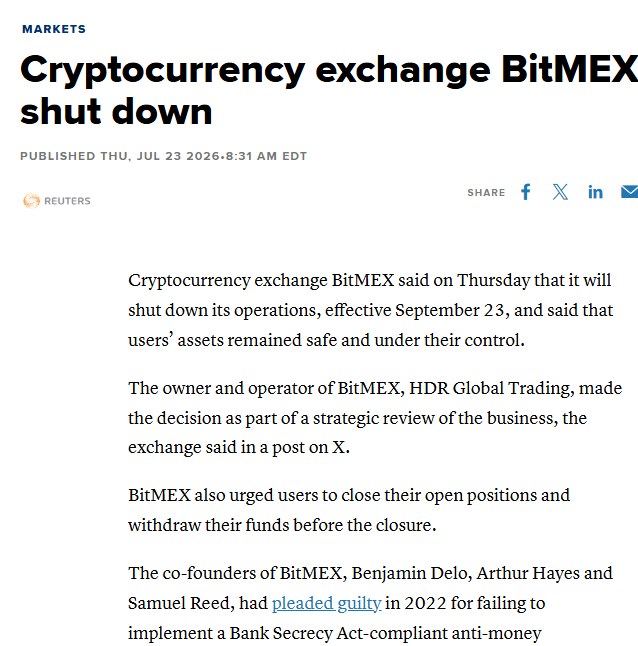 BitMEX: a strategic wind-down, not a failure. User assets stayed under user control.
And Bitcoin did not make a new low. BTC entered August around $64,000, roughly 50% below the October 2025 high of $126,209, after a 9.8% July rebound. Four days of hardware-wallet headlines, two exchange shutdowns, no fresh leg down — the marginal seller is exhausted, which is precisely why bad news has stopped moving price. The macro is turning with it: DRAM contract prices are projected to rise 13–18% QoQ in Q3 2026, down from roughly 60% in Q2, so the memory supercycle that vacuumed capital out of every other risk asset is decelerating.
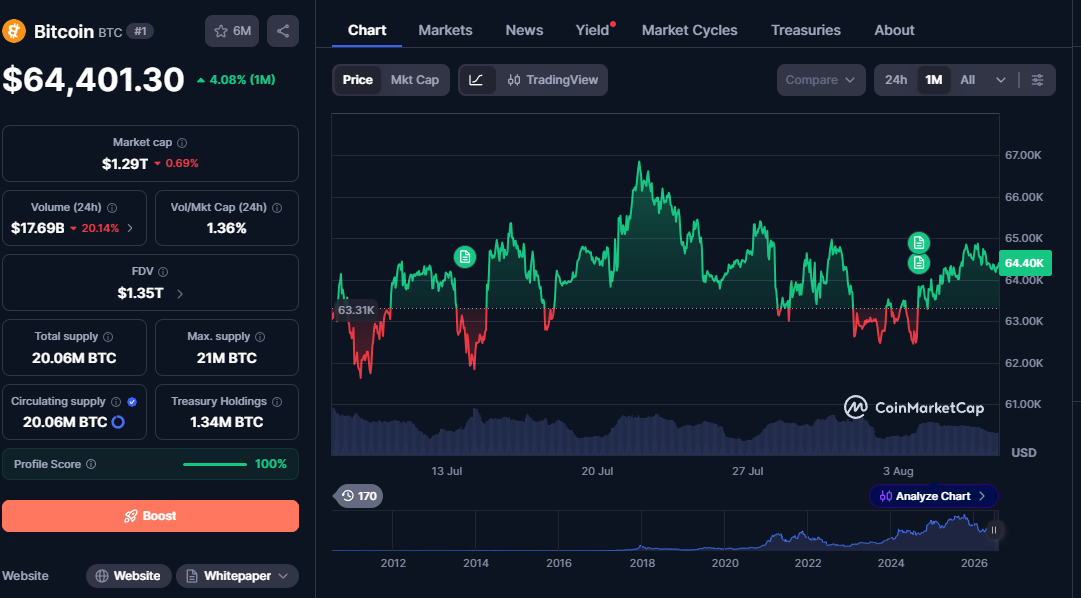 BTC at $64,401, up 4.08% on the month. A month of bad headlines and the chart barely moved.
Our research team's view: the broad bottom for Bitcoin is in. If DeFi is not your thing, accumulating major crypto assets here is a defensible entry — see the final section.
As a benchmark, Robinhood's cash account pays 3.5% APY (with a recurring direct deposit). Anything below that, at comparable risk, is not worth the on-chain complexity.
| Position | Protocol | APY | Safety Score | Risk | Where the yield comes from |
|---|---|---|---|---|---|
| LP-sUSDe (Monad) | Pendle / Ethena | 12.0% | 85 | Low | ~4% native sUSDe + ~8pp Monad incentives |
| Loop sUSDS/USDT | Morpho / Sky | 30.13% at 14.9× | 82 | Low-Medium | Sky Savings Rate minus USDT borrow cost, levered |
| PT-sUSDai Oct-26 | Pendle / USD.AI | 9.65% | 73 | Medium | GPU-backed lending, yield fixed at purchase |
| PT-sUSDai Feb-27 | Pendle / USD.AI | 9.28% | 73 | Medium | Same, longer lock |
| PT-reUSDe Dec-26 | Pendle / Re | 17.55% | 61 | Medium-High | On-chain reinsurance premiums, junior tranche |
| PT-apyUSD Aug-26 | Pendle / Apyx | 17.49% | 57 | High | STRC preferred-share dividends |
| Loop apyUSD/USDC | Morpho / Apyx | 32.56% at 4.5× | 41 | High | Same, levered |
| YT-apyUSD (Aug/Nov) | Apyx | ~55% total | — | Very High | Season 2 points airdrop |
| YT-USDAI Oct-26 | USD.AI | ~69% total | — | Very High | CHIP points airdrop |
All figures are live as of August 7, 2026 and change daily — verify before investing. Safety Scores are DeFi Sentinel's 0–100 strategy grade. YT rows show total return over the position's life, not annualized.
This is the single best risk-adjusted position we see this month, and it exists for a boring reason: someone else is paying for it.
The underlying is sUSDe — Ethena's staked synthetic dollar, backed by tokenized US Treasuries plus a delta-neutral basis position. Its native yield right now is roughly 4%. The Pendle LP pool for sUSDe on Monad is paying 12%. That ~8-point gap is not yield; it is Monad subsidising liquidity onto its chain. Monad has been spending aggressively to bootstrap DeFi — its AUSD pools on Pendle carry up to $75K–$100K per week in direct rewards, and Pendle crossed $111M TVL on Monad within a month of launching there.
Why the risk stays low despite the headline number: impermanent loss on a Pendle LP is structurally small, because PT and its underlying converge to 1:1 at maturity (October 22, 2026). Hold to maturity and IL is near zero. The credit risk is Ethena's, which has now traded through several full cycles.
What breaks it: the incentive, not the asset — subsidies get cut with no notice, leaving you on a ~4% position on a thin chain. You also have to bridge into Monad and back out, and that exit is the part people underestimate.
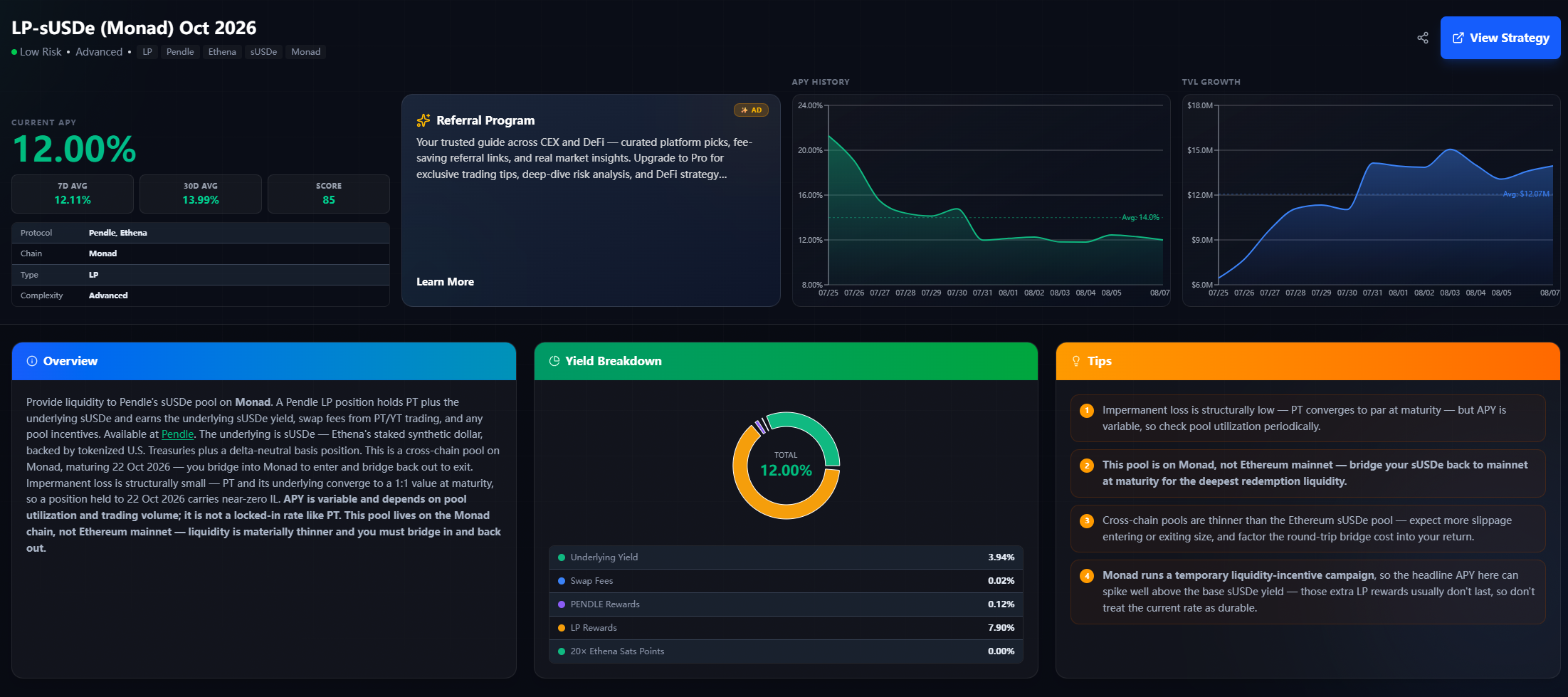 The yield breakdown is the whole argument: 3.94% underlying, 7.90% LP rewards. Two-thirds of this rate is someone else's money.
→ LP-sUSDe (Monad) Oct 2026 on DeFi Sentinel
We generally advise against looping, and we have written at length about why. This is the exception that proves the rule, because both legs are unusually benign.
The collateral is sUSDS — Sky's savings token, currently accruing a 3.52% Sky Savings Rate, and one of the highest-rated assets on our board. The debt is USDT, borrowed on Morpho Blue at 1.61% today. A ~1.9-point spread on a stablecoin pair, at a 96.5% LLTV, is a lot of room. At 14.9× leverage — half the maximum — that compounds to a net 30.13% APY, and the position still scores 82.
What breaks it: the borrow rate, which is a utilization curve, not a fixed rate — ten days ago this market charged 3.4%, today 1.61%, and at this leverage a two-point move swings your net APY by roughly thirty. On Morpho Blue there is no e-mode and no warning band, so 96.5% LLTV is both the borrow cap and the liquidation price — at 14.9× a mere 3.3% drop in the collateral price liquidates you, so leave real headroom and check the rate weekly.
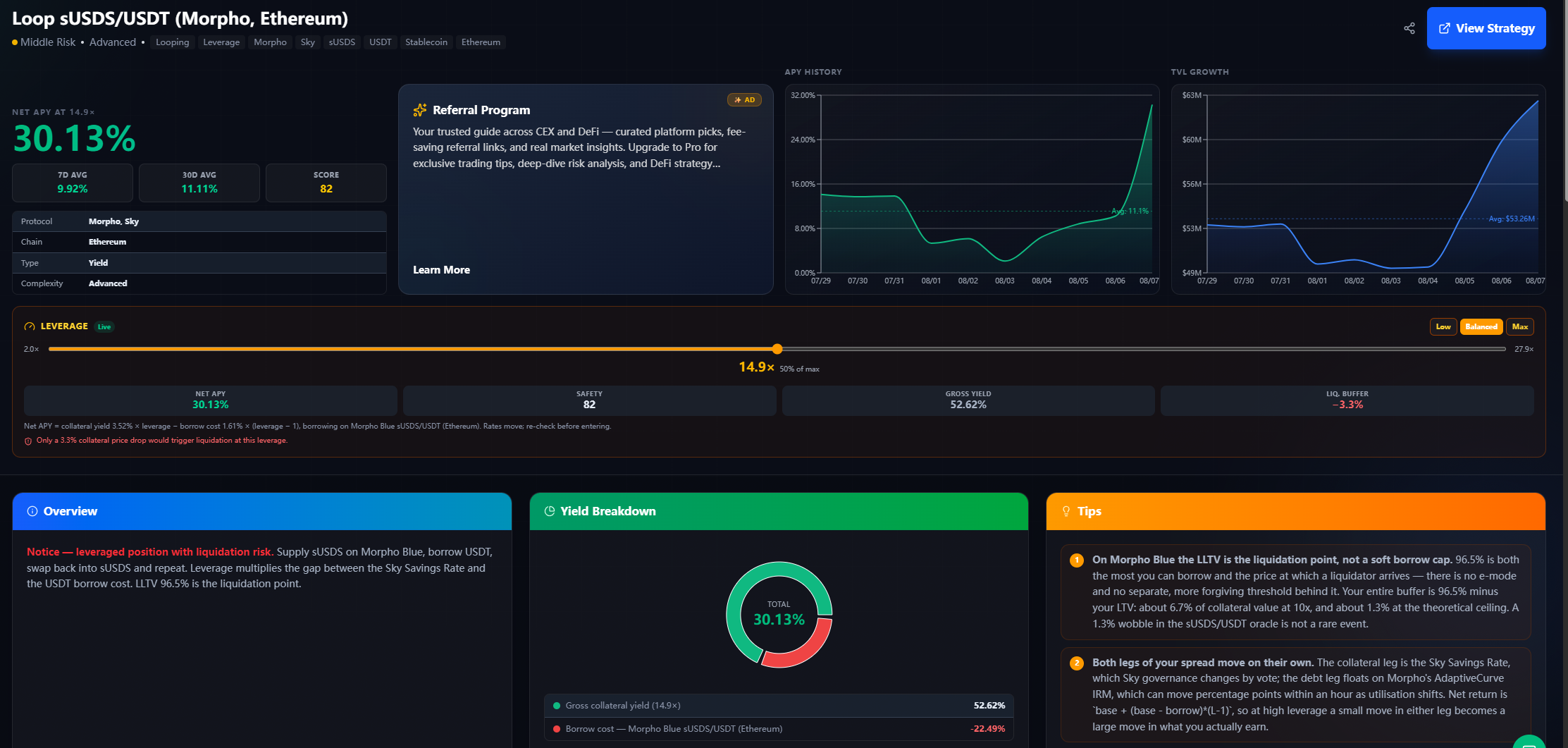 52.62% gross collateral yield against a −22.49% borrow cost. The liquidation buffer, −3.3%, is the number to watch, not the APY.
→ Loop sUSDS/USDT on DeFi Sentinel
Last month we made the case for USD.AI's GPU-backed lending at a moment when the model was still unproven to most readers. A month on, nothing has broken, and the underwriting case has quietly strengthened.
The fixed-rate options:
Prefer the shorter maturity. The rates are nearly identical, so the longer PT pays you almost nothing for four extra months of credit exposure to an AI-capex cycle that could look quite different by February. When the term structure is this flat, duration is a free risk you are not being compensated to take.
Why we are comfortable at ~10%: the GPU rental market is holding. Secondary-market GPU prices remain strong and rental rates have not come down — which is exactly the variable that matters, since the loan book is collateralised by compute hardware. The danger signal we flagged in July is unchanged: sustained H200 rental rates falling toward $2/hour would mean the collateral is repricing. They have not.
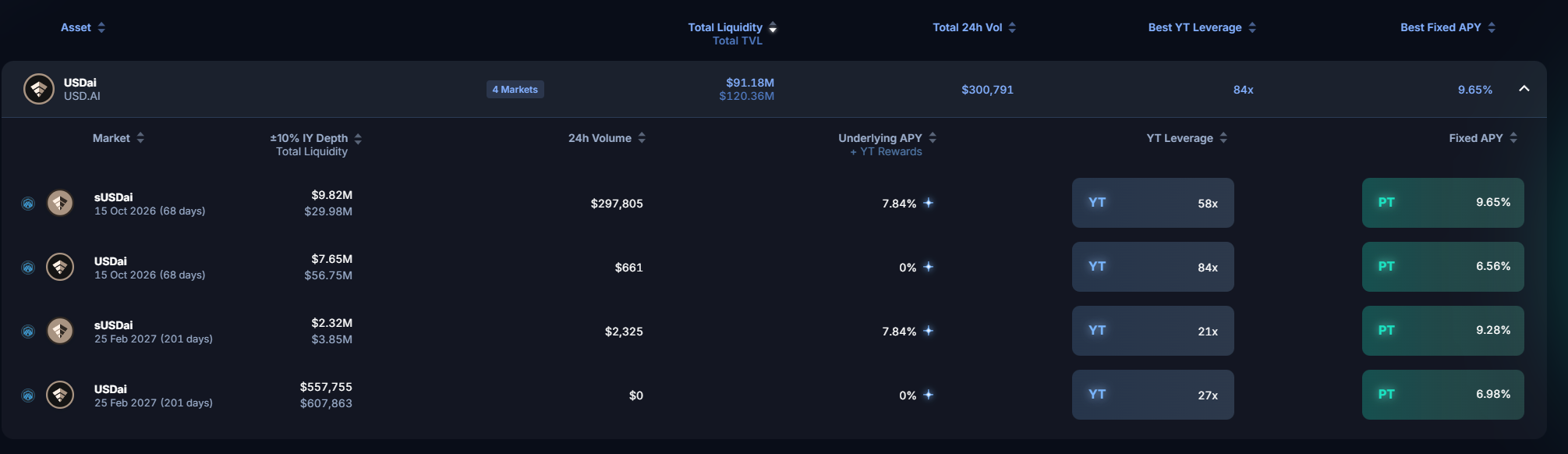 The October sUSDai market carries $9.82M of depth against February's $2.32M — the shorter maturity is also the more liquid exit.
→ PT-sUSDai (Arbitrum) Oct 2026
Little has changed at Re since last month, which for an on-chain reinsurance book is the good outcome. The December 10, 2026 maturity is where the yield is:
Take the PT. When the fixed and floating legs pay the same, the fixed leg is strictly better: PT locks your return the moment you buy, while the LP's yield depends on pool utilization and trading volume for the next four months. You are being offered certainty for free. Take it.
What breaks it: PT fixes the yield, not the credit — reUSDe is the junior tranche and absorbs losses before reUSD, so a bad claims year means redemption below par. The calendar is against you too: you hold it straight through hurricane season, which peaks in September with August and October as the shoulders.
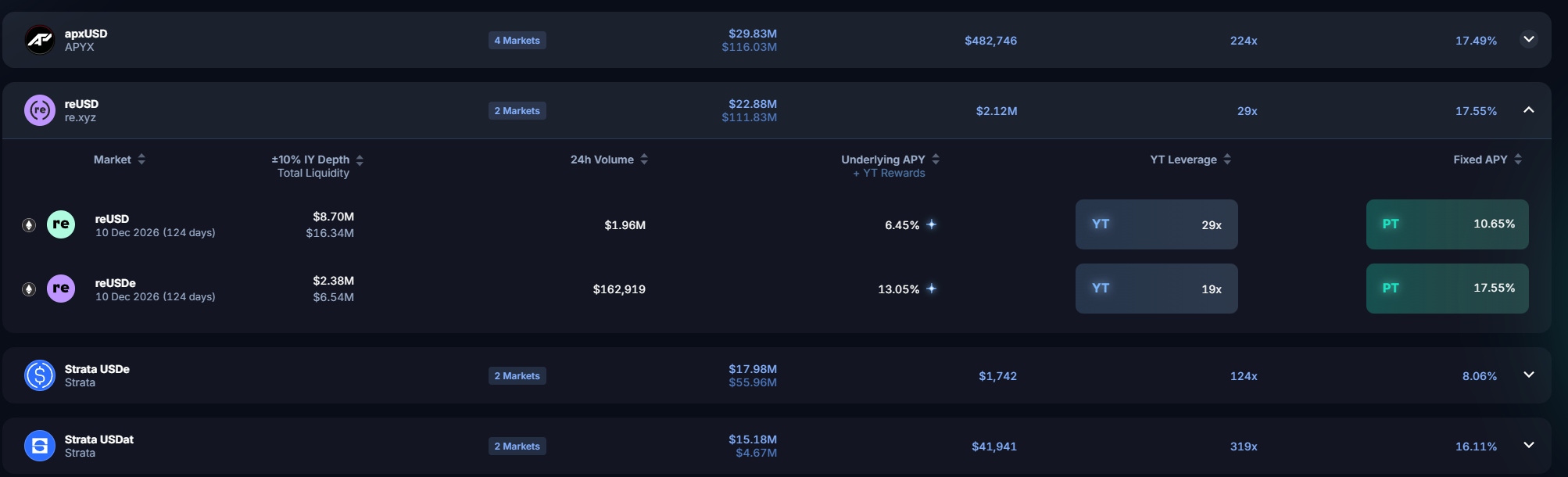 The two tranches side by side. The ~7-point step from reUSD to reUSDe is exactly the price of sitting lower in the loss waterfall.
→ PT-reUSDe (Ethereum) Dec 2026
Everything in this section rests on one security, so understand it before you touch any of it.
apxUSD is Apyx's synthetic dollar, overcollateralized by dividend-bearing DAT preferred shares. The dominant one is STRC — Strategy's (formerly MicroStrategy) Variable Rate Perpetual Stretch Preferred Stock, designed to hold a $100 peg. apyUSD is the yield-bearing wrapper whose value grows as those dividends accrue.
The reason this complex is investable again is a governance signal, not a yield signal. Over the past several weeks Strategy has: held the STRC dividend at 12% annualized for August; sold 1,638 BTC for ~$105M and routed the proceeds into preferred dividends and STRC buybacks; repurchased 912,143 STRC shares for $81.2M; and issued ~$291M of new MSTR common to help fund it. STRC has recovered to roughly $94 against its $100 par — up more than 30% from its June low.
Read that capital flow plainly. The board is selling Bitcoin and diluting common shareholders to defend the preferred. Whatever you think of it as an MSTR equity holder, if you are a STRC holder it is unambiguous: your claim now sits ahead of the common. That is what makes the apxUSD/apyUSD complex tradeable again — and it is also the exact assumption that would have to break for these positions to fail.
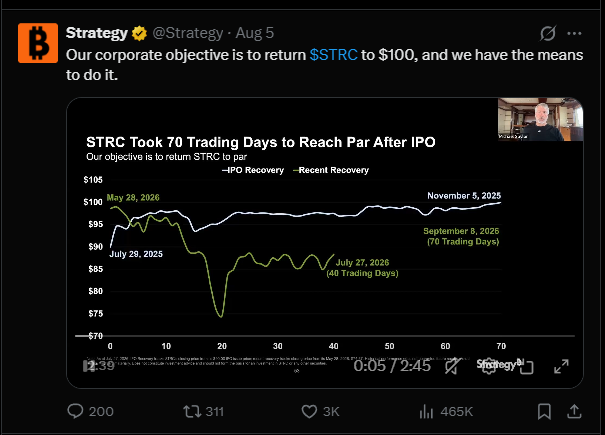 Stated on August 5. "Our corporate objective is to return STRC to $100, and we have the means to do it."
A fixed 17.49% maturing August 27, 2026 — under three weeks. Short duration is doing a lot of work here: your STRC exposure is measured in days, and Strategy has already declared the August dividend. There is a longer PT-apyUSD Nov-26 at 15.49% if you want the term.
What breaks it: an STRC depeg — if STRC falls, the collateral behind apxUSD loses value and your PT can redeem below par. Note also the ~20-day cooldown on unwinding apyUSD back to apxUSD, and that apyUSD is a young asset DeFi Sentinel has not yet rated.
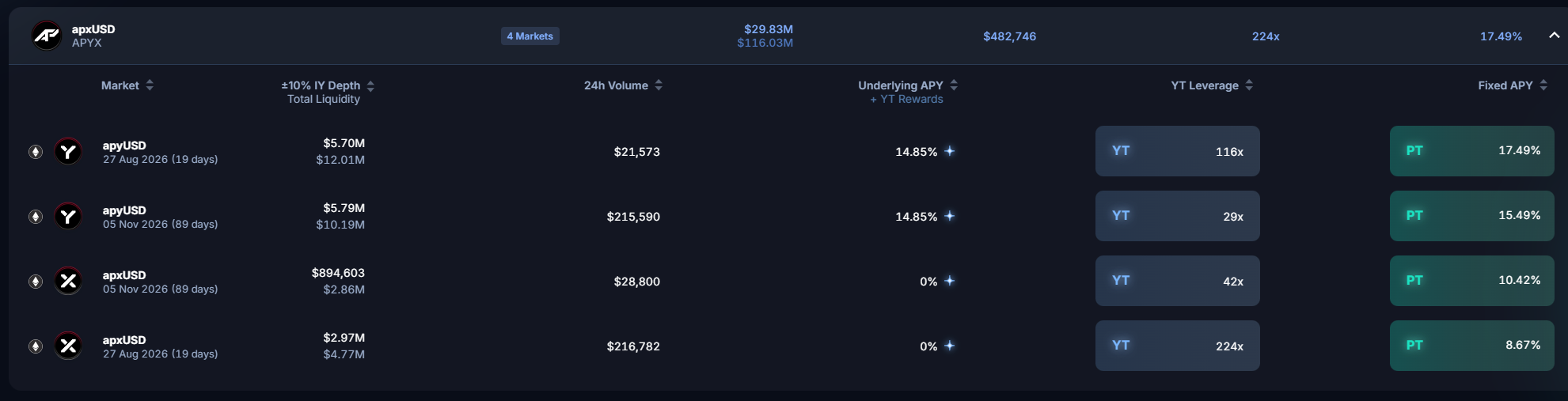 The four Apyx markets. apyUSD carries a 14.85% underlying; apxUSD carries none, which is why its PT prices lower.
→ PT-apyUSD (Ethereum) Aug 2026
Supply apyUSD on Morpho Blue at 14.71%, borrow USDC at 9.61%, repeat. At 4.5× — again half the maximum — the site shows 32.56%. It is the highest stablecoin-denominated yield on our board and it carries our lowest Safety Score: 41. Both facts have the same cause.
What breaks it: everything at once — apyUSD tracks an STRC-dominated reserve and can fall (this is a levered preferred-share position, not a par-pegged stablecoin loop), 86% LLTV is the liquidation price, and the borrow rate has climbed from 6.3% to 9.61% in ten days, compressing the spread from 8.5 points to 5. This is not hypothetical: an STRC selloff has already pushed the sister token apxUSD to roughly $0.90–0.93, and at 4.5× your liquidation buffer is 9.6%. Take it small and watch it daily.
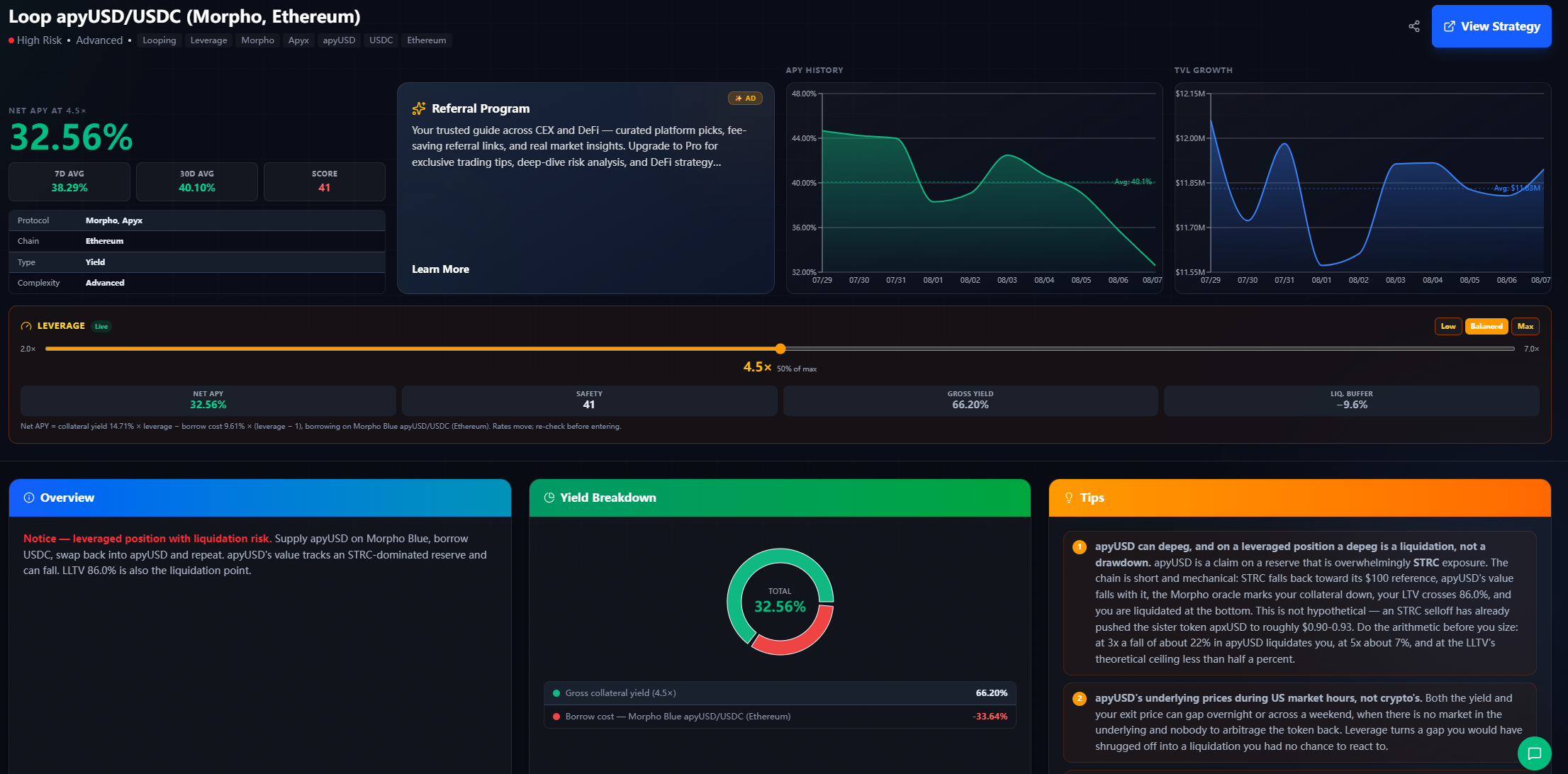 66.20% gross against a −33.64% borrow cost. Note the APY history: this rate has been falling all week as the borrow leg climbs.
→ Loop apyUSD/USDC on DeFi Sentinel
Two points seasons close in October, roughly two months out. Both are priced, both are modellable, and both are the highest-variance thing in this guide. YT decays to zero — if the airdrop disappoints, you lose most of your stake. This is the speculative sleeve, not the income sleeve.
The figures below are total return over the position's life, not annualized, computed with our live calculators.
Season 2 allocates 6% of supply and ends October 13, 2026. Our APYX calculator defaults to a $100M FDV opening assumption, which is where these land:
| YT market | Expiry | Total return at $100M FDV | At $200M FDV |
|---|---|---|---|
| apyUSD Aug | Aug 27, 2026 | +56% | +81% |
| apyUSD Nov | Nov 5, 2026 | +57% | +78% |
| apxUSD Aug | Aug 27, 2026 | +18% | +136% |
| apxUSD Nov | Nov 5, 2026 | ~0% | +74% |
The two apyUSD markets are the lowest-risk expression — they carry the underlying's ~14.9% yield alongside the points, so part of your cost is repaid in cash flow regardless of what the token opens at. The apxUSD legs are pure points bets: far more torque if the airdrop prices well, and roughly nothing if it does not.
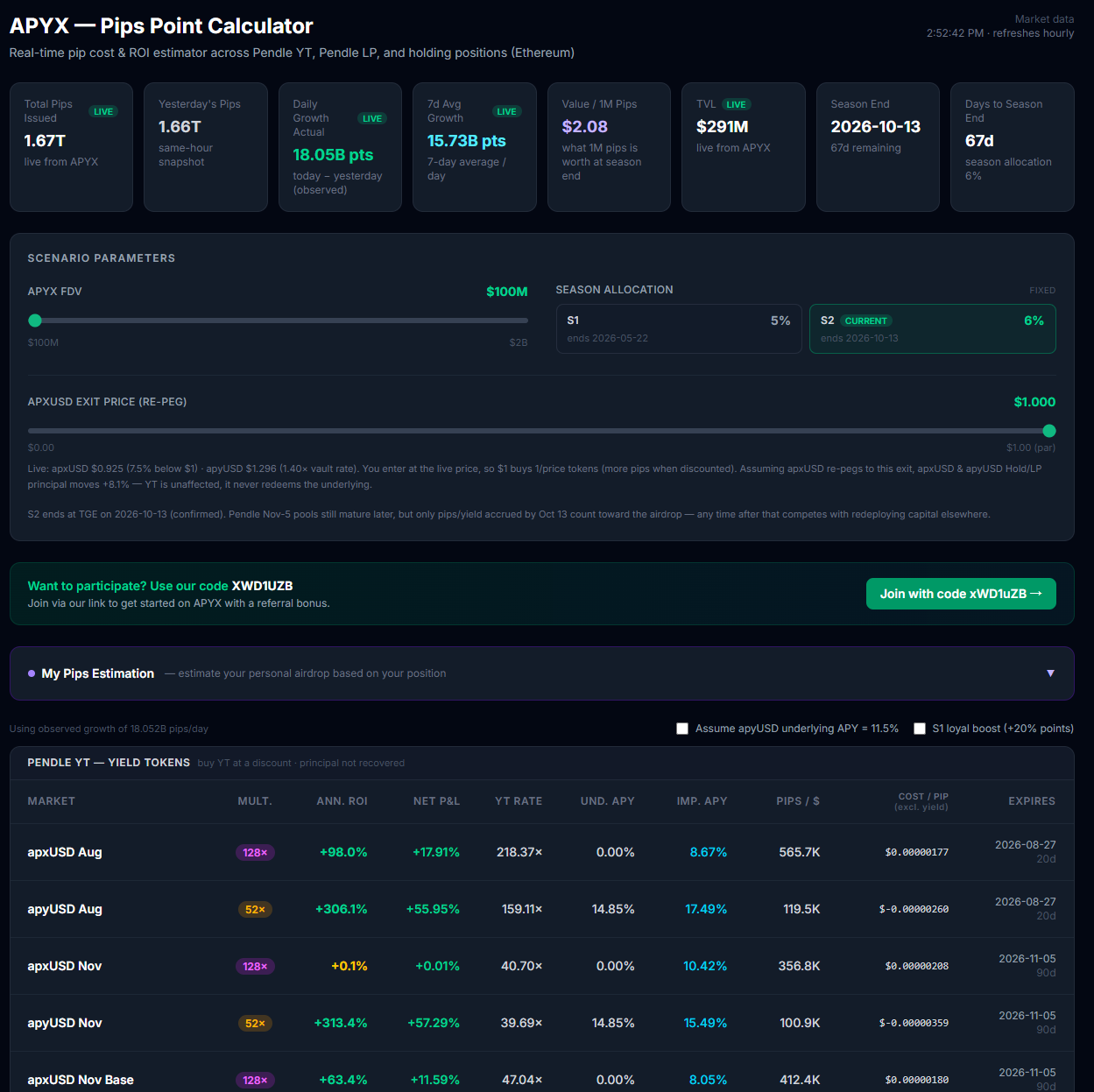 Season 2 ends at TGE on October 13. Move the FDV slider yourself before committing to any of these.
→ APYX YT calculator · Apyx referral link
CHIP currently trades at $0.0251, a $251M FDV, with the season ending October 15, 2026 — about ten weeks. At the live FDV:
| YT market | Expiry | Total return at $251M FDV | At $200M FDV |
|---|---|---|---|
| YT USDAI Oct-26 | Oct 15, 2026 | +69% | +35% |
| YT sUSDAI Oct-26 | Oct 15, 2026 | +50% | +38% |
| YT USDAI Feb-27 | Feb 25, 2027 | +21% | +10% |
| YT sUSDAI Feb-27 | Feb 25, 2027 | +20% | +15% |
The reason we are willing to underwrite this: there is not much time left for the price to break. Two months is a short window for a token with a live, functioning lending business behind it to collapse. Model a conservative drawdown to a $200M FDV and the October markets still return 35–38%. That is a wide margin of safety for a points trade.
Prefer the October maturities over February for the same reason as the PTs — the season-end airdrop is in October, so the February markets tie up capital past the event that creates the value.
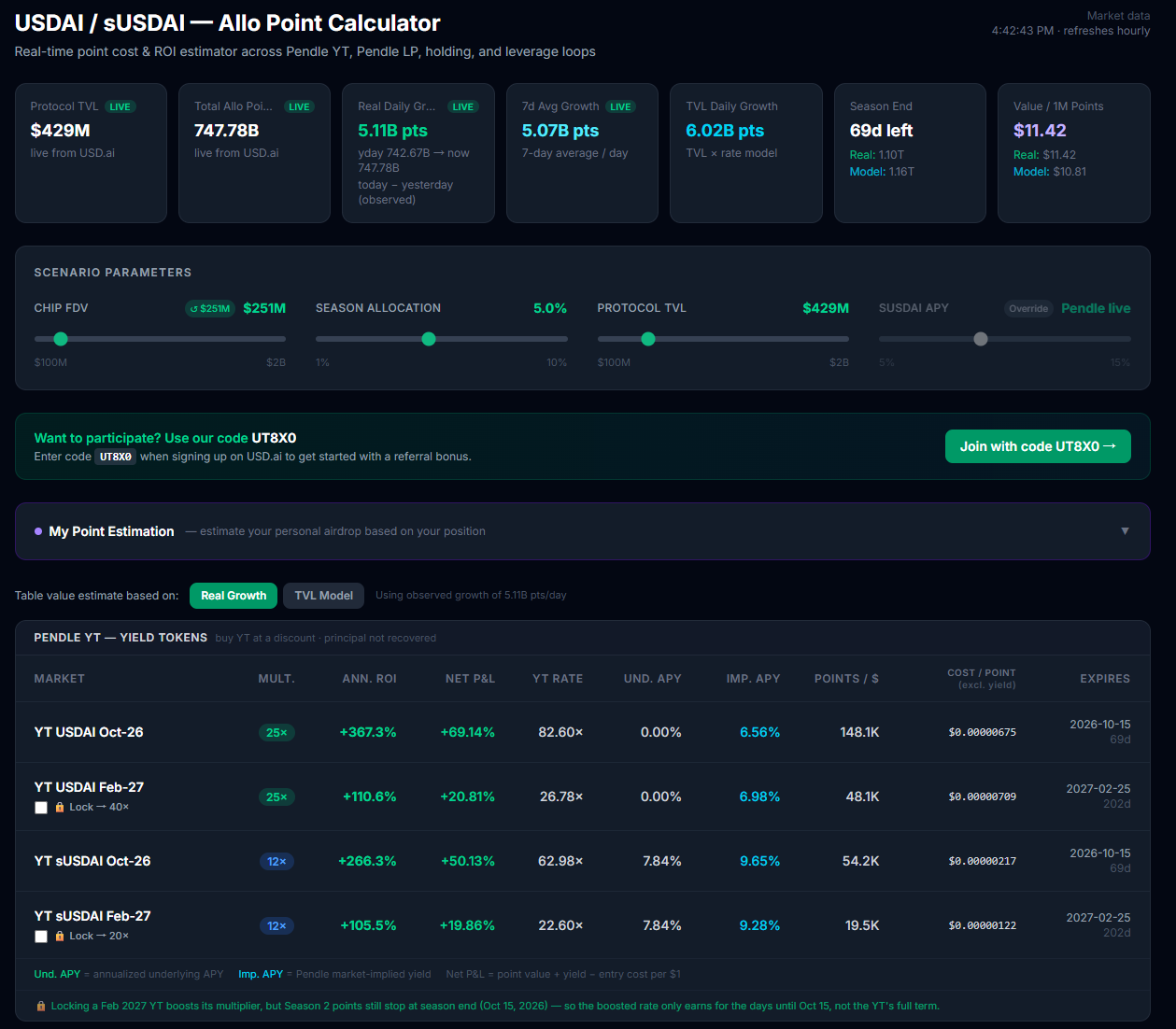 69 days to season end, $11.42 per million points. The February rows carry a lock multiplier that only earns through October 15 — which is why they read worse, not better.
→ USD.AI YT calculator · USD.AI referral link
Both links above are referral links. They cost you nothing and, on USD.AI, currently add a 10% points bonus.
Back to the opening argument. Bitcoin absorbed a $116M hardware-wallet exploit and two exchange wind-downs without making a new low, sitting ~50% below the cycle high while the AI capex trade that drained liquidity from it decelerates. Reward-to-risk on BTC and ETH at these levels is the best it has been this cycle. If you have no interest in the positions above, that is the simplest thing to do with the observation.
For DeFi tokens specifically, do not buy on narrative. We built /tools/tokens to value all twelve major DeFi tokens on the same basis — the methodology is here. The key metric is net holder yield: income actually reaching holders, minus the dilution they absorb from unlocks and emissions, over market cap. It is negative far more often than yield tables suggest.
Current readings (90-day basis, live scenario):
| Token | Net holder yield | Forward dilution | Modelled bull case |
|---|---|---|---|
| PUMP | +6.6% | 20.8% | +64% |
| JUP | +4.4% | 0.0% | +237% |
| CAKE | +3.9% | 2.4% | +193% |
| LDO | +3.6% | 0.7% | +282% |
| PENDLE | +1.5% | 3.3% | +322% |
| AERO | −0.3% | 24.6% | +180% |
| MORPHO | −10.3% | 19.7% | −14% |
| LIGHTER | −22.7% | 46.4% | +121% |
Two different questions, two different answers. On net holder yield — what you get paid to hold — PUMP, JUP, CAKE and LDO are the standouts, and the reason is visible in the dilution column: JUP, CAKE and LDO have almost no forward supply overhang, so nearly all of their revenue reaches holders. LIGHTER's −22.7% is the counter-example: a respectable 5.1% gross yield entirely swamped by 46.4% forward dilution.
On upside, the model reads highest for PENDLE (+322%), LDO (+282%) and JUP (+237%). LDO is the interesting one — it pairs the third-best net yield with the best reward-to-risk ratio on the board, because its modelled downside is only about −22% while everything else risks 60–90%.
But treat the upside column as an input, not an output. It is calibrated against last cycle's fee peaks, and it assumes this cycle rhymes. That assumption is doing an enormous amount of work. The tool lets you set your own peak-share and fee assumptions — do that before acting on any of these numbers.
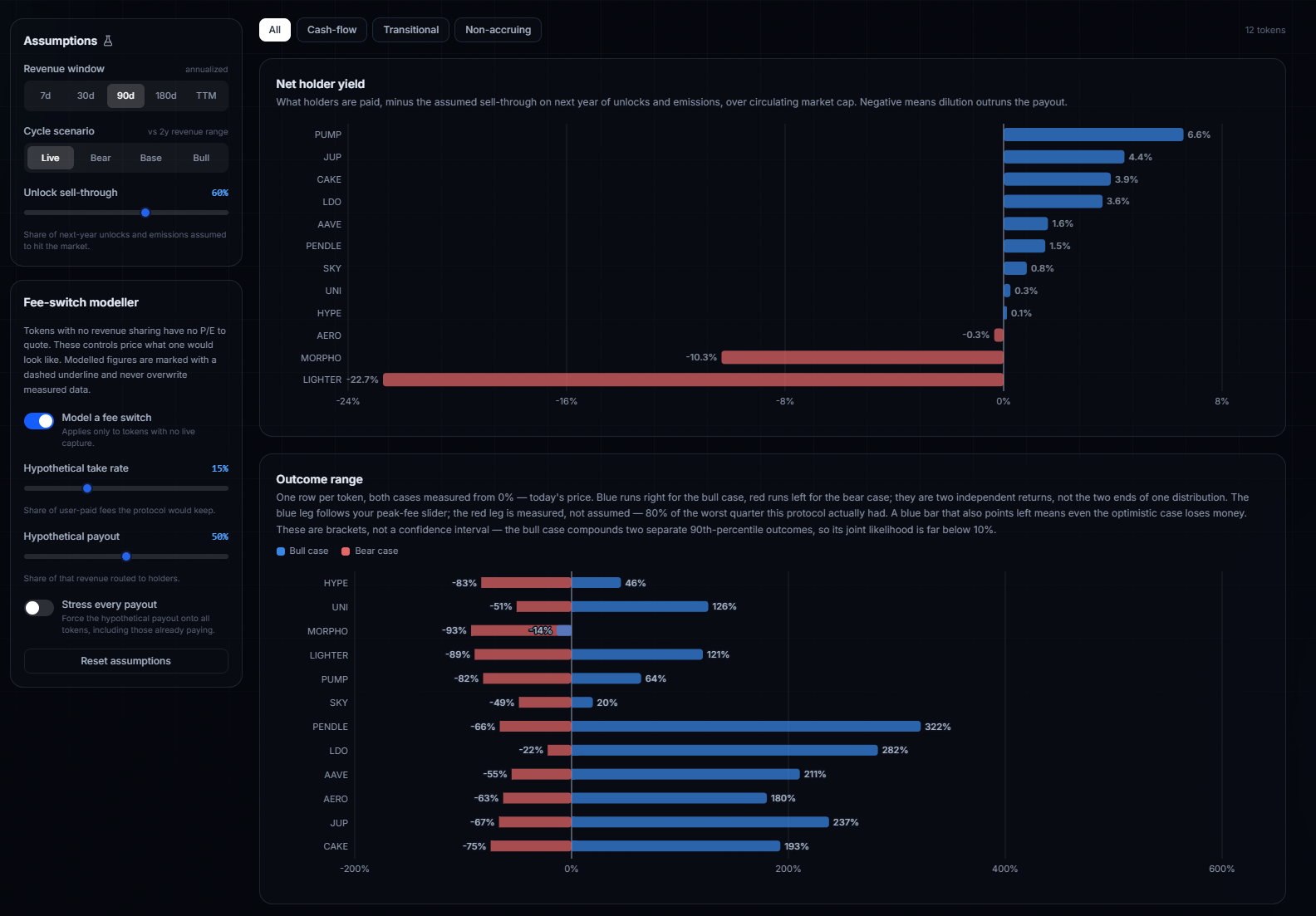 Both charts at once. Note how little the two rankings have in common: the tokens that pay you best are mostly not the ones with the most upside.
That is the August guide. Between an incentive-subsidised LP at 12%, a fixed 10% on GPU credit, a 17.5% reinsurance PT, two points seasons closing in October, and the best spot entry of the cycle, there is more opportunity here than the headlines suggest. Which is usually the point.
This guide is for informational purposes only and is not financial advice. Yields, maturities, borrow rates and risk conditions change quickly — always verify current figures on-chain before investing, and never commit more than you can afford to lose.
On a risk-adjusted basis, the LP-sUSDe pool on Monad leads at 12% with a Safety Score of 85 — roughly 4% is native Ethena yield and the rest is Monad liquidity subsidy. Behind it sits a looped sUSDS/USDT position paying 30.13% at 14.9x leverage and still scoring 82, fixed-rate PT-sUSDai at 9.65% on GPU-backed credit, and PT-reUSDe at 17.55% from on-chain reinsurance. Higher numbers exist in the STRC complex, but they score 41-57 for a reason.
Our research team thinks so, on evidence rather than hope. Bitcoin entered August 2026 near $64,000 — about 50% below the October 2025 high of $126,209 — and absorbed a $116M Coldcard hardware-wallet exploit plus two exchange wind-downs without making a new low. When bad news stops moving price, the marginal seller is exhausted. The memory-chip supercycle draining liquidity from crypto is also decelerating, from ~60% QoQ DRAM price growth in Q2 to 13-18% in Q3.
Starting July 30, 2026, an attacker drained roughly 1,816 BTC (~$116M) from over 5,200 addresses by exploiting a five-year-old firmware flaw in Coinkite's Coldcard. An incorrect check made ngu.random fall back to MicroPython's deterministic Yasmarang generator instead of the STM32 hardware RNG, seeding wallets from the microcontroller ID and system timing. Any seed generated on affected firmware between March 2021 and the patch is guessable and should be migrated immediately.
Take the PT. PT-reUSDe pays 17.55% fixed and LP-reUSDe pays 17.02% variable for the same December 2026 maturity — when the fixed and floating legs are level, the fixed leg is strictly better because it locks your return at purchase while the LP depends on pool utilization and trading volume for months. You are being offered certainty at no cost. PT fixes the yield, though, not the underlying credit risk.
Only as a speculative sleeve, because YT decays to zero and a disappointing airdrop costs you most of your stake. Two seasons close in October 2026: APYX Season 2 on October 13 and USD.AI's CHIP on October 15. At current pricing, YT-USDAI Oct-26 returns about 69% over the position's life at CHIP's live $251M FDV, and still 35% if FDV falls to $200M. Prefer maturities at or before the airdrop date.
Net holder yield is income actually reaching token holders minus the dilution they absorb from unlocks and emissions, over market cap. It is negative far more often than gross yield tables suggest. On a 90-day basis the leaders are PUMP at +6.6%, JUP at +4.4%, CAKE at +3.9% and LDO at +3.6% — the last three because they carry almost no forward supply overhang. LIGHTER is the counter-example at −22.7%, where 46.4% forward dilution swamps a respectable gross yield.

Practitioner turned analyst tracking how incentives, liquidity, and capital flows shape DeFi protocols.


